Direct Bookings for Hotels: The Complete Guide to Cutting OTA Commissions
Every booking that comes through Booking.com or Expedia costs you 15-25% in commission. This guide covers exactly how to build a direct booking channel that earns guests back — from parity strategy to the booking engine itself.
The Real Cost of OTA Dependence
Booking.com and Expedia typically charge 15-25% commission per booking. On a KES 15,000/night room, that's KES 2,250-3,750 gone before you've paid for a single guest amenity. Book the same room directly and that entire margin stays with the property.
Key Point
OTAs aren't the enemy — they're a discovery channel. The problem is when a property has no real alternative, so every guest who finds you on Google still books through the OTA out of habit. The fix isn't leaving OTAs; it's giving guests a reason to book direct once they've found you.
Why Guests Book Through OTAs Anyway
Most hotels lose direct bookings for reasons that have nothing to do with price:
- •No visible "Book Now" path — the website exists, but booking still means a phone call or WhatsApp message
- •Trust — OTAs have reviews, cancellation policies, and payment protection guests already recognize
- •No price incentive to switch — if the direct rate is identical to Booking.com, there's no reason to leave a platform they already trust
- •Slow or broken booking flow — multi-step forms, no real-time availability, or a redirect to an email inquiry instead of instant confirmation
Fix the visible path and the incentive, and a meaningful share of guests who already found you through Google or social will book direct without you losing a single OTA listing.
Choosing a Booking Engine
For independent hotels and villas in Kenya, the booking engine decision usually comes down to a channel manager with a built-in booking widget (like Zeevou, Beds24, or Lodgify) versus a standalone booking button. Which one makes sense depends on how many channels you're already managing:
If you list on 2+ OTAs already
A channel manager (Zeevou, Beds24, Lodgify) syncs your calendar across every platform automatically, so a direct booking blocks the room everywhere else in real time. Without this, double bookings are just a matter of time.
If you want to appear in Google Hotel Search
This requires a Google Hotel Center price feed (an XML feed of your live rates and availability) connected to a booking engine that can accept the booking. It's a separate integration from your channel manager, and it's one of the highest-intent placements available — those are travelers actively comparing prices to book, not just browsing.
If you're a single small property
A lightweight booking widget embedded directly on your website may be enough, provided it shows real-time availability and confirms instantly — a "request to book" form that requires a manual reply defeats the purpose.
Rate Parity Without Losing Money
Most OTA contracts include a rate parity clause — you can't list a lower price on your own website than on their platform. That doesn't mean you can't win the booking. It means the advantage has to come from somewhere other than a lower headline rate:
- •Free breakfast, late checkout, or a welcome drink included only for direct bookings
- •A best-price guarantee, so guests don't need to price-compare elsewhere
- •Flexible or free cancellation direct, where the OTA rate is non-refundable
None of this requires undercutting the OTA rate — it requires making the direct booking clearly worth more for the same price.
Recovering Guests Who Almost Booked
Not every guest who starts a booking on your website finishes it. They add dates, see the price, and then leave — sometimes to compare against Booking.com, sometimes just distracted. This happens more than most properties realize, and unlike a booking made on an OTA, it's one you can actually try to recover.
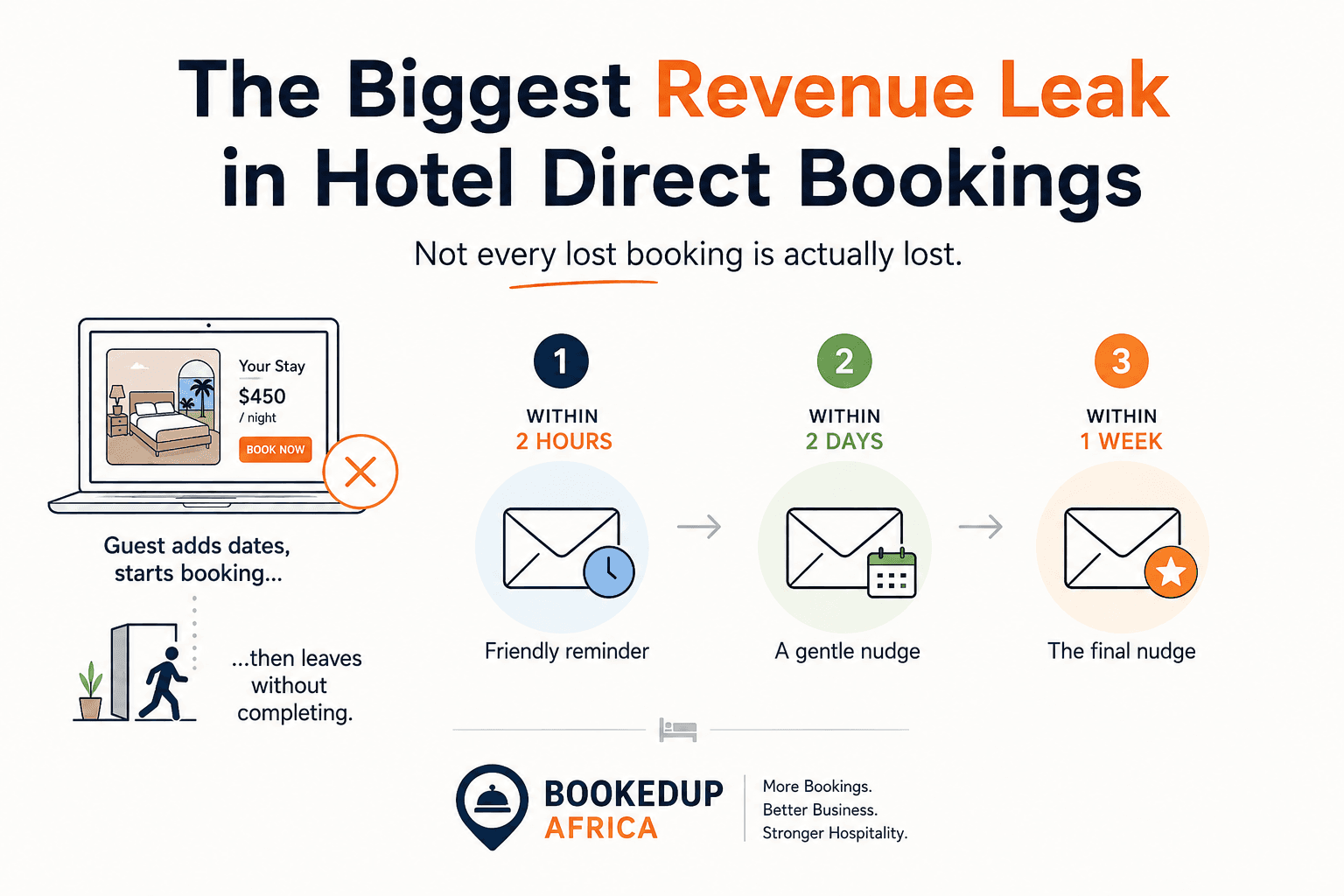
A simple three-touch recovery sequence for abandoned bookings.
The sequence works because it escalates gently rather than pushing hard immediately: a friendly reminder within 2 hours catches guests who just got distracted, a gentle nudge within 2 days reaches those still deciding, and a final nudge within a week — often paired with a small incentive — catches the rest before they book elsewhere entirely. This only works if your booking engine actually captures the guest's email before checkout completes, so it's worth checking whether yours does before assuming this is available to you.
Direct Booking Incentives That Work
- • A visible "Book Direct & Save" or "Book Direct, Get [X]" banner on every page, not just the homepage
- • An email to past OTA guests after checkout, thanking them and offering a direct-booking discount for their next stay
- • A dedicated "Direct Booking Perks" section on the room/rates page, listed clearly against the OTA price
- • WhatsApp as a fallback for guests who want to ask questions before booking — but the booking button should always come first
Direct Booking Checklist
Frequently Asked Questions
Will pushing direct bookings hurt my OTA ranking?▼
No — OTA rankings are driven by conversion rate, reviews, and response time on their platform, not by how many bookings you get elsewhere. You can grow both channels at once.
Do I need a channel manager if I only list on one OTA?▼
It's less urgent, but still worth it once you add a direct booking engine — you now have two calendars to keep in sync, and a missed update is a double booking.
What share of bookings should realistically go direct?▼
It depends heavily on your local search visibility and repeat guest base, but a well-run direct channel with strong local SEO can realistically shift 20-40% of bookings away from OTAs over time.
Ready to Cut Your OTA Commission Bill?
As a hotel digital marketing agency in Kenya, we set up booking engines, channel managers, and direct-booking strategy end to end — including Google Hotel Search integration.
Claim My Free Strategy Call →